Methods, Frameworks and Tools

This page gathers together a selection of methods, frameworks and tools I have found useful in my work in evaluation, research, strategy and organisational development.
A Data Analysis Tool
Actually this is one of those interesting little tools that defies categorisation. It's not just a data analysis tool; I've used it a lot when presenting results of research to stakeholders and to help people debrief unstructured meetings.
One of the big challenges in evaluation or any applied social science or consultancy task is how to help people engage with the results, especially when those results are uncomfortable. One way of overcoming this is to engage them in the actual data analysis
But how do you do this? Isn't data analysis a highly specialised technical activity? Well it all depends on how you do it, and this approach has been widely used by my colleagues in Aotearoa.
Inspired by Vygotskyian psychology and Activity Theory, the method distinguishes between patterning (fitting current events into past events) and puzzling (seeking explanations when current events do not fit past or other current events).
Much conventional analysis removes outliers, which eliminates opportunities for puzzling and learning; this tool encourages people to explore the relationship between typical data and outliers instead.
Download: Data Analysis Tool (PDF)
A Decision Making Tool
We take decisions all the time and are often so used to doing it that we forget to check with others who might be affected how they would like to be involved.
This simple tool sets out four basic ways to make decisions and emphasises the importance of clear agreements about which mode is appropriate in a given situation.
Download: A Decision-Making Tool (PDF)
A Listening Tool
In group discussions, ideas and responses often flow so quickly that very little listening actually occurs, which can leave issues unexamined.
This tool helps when a group is “wheel spinning” or skimming the surface, by slowing the process down so that people start listening and addressing the core of the issue.
Download: A Listening Tool(PDF)
The Powercube
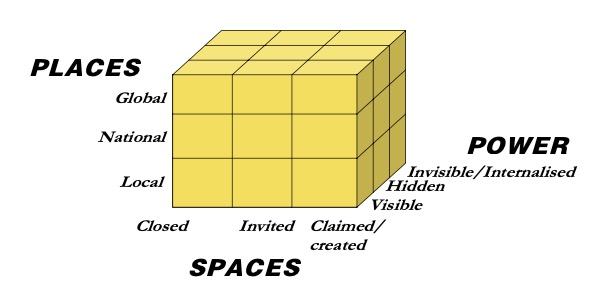
This is an absolute gem. Power is one of those frustrating concepts that occur frequently in evaluation, organisational development and systemic practice. It is frequently identified but poorly conceptualised and largely viewed largely through negative lenses. The Powercube is an antidote. It explores three dimensions of power: forms, spaces and places, and within each dimension three ways it is expressed. The brilliant, if somewhat old school, website has specific examples of how to identify the combinations in which these three dimensions can be visualised, expressed, challenged or strengthened depending on the situation. It contains sample workshop plans and loads of examples.
The pedegree is respectable; it originated from work done at the Institute of Development Studies at Sussex University in the UK. And despite its age (dating back nearly 30 years) it is still regarded as a go to resource.
Download: Power Cube (PDF)
Option One-and-a-Half
Bob Dick's brilliant process helps people resolve apparently irreconcilable differences in groups and comes from his book Helping Groups to be Effective, which I regard as one of the best facilitation and group work books available.
Download: Option One-and-a-Half (PDF)
What helps, what hinders? Force Field Analysis and Assumption-Based Planning
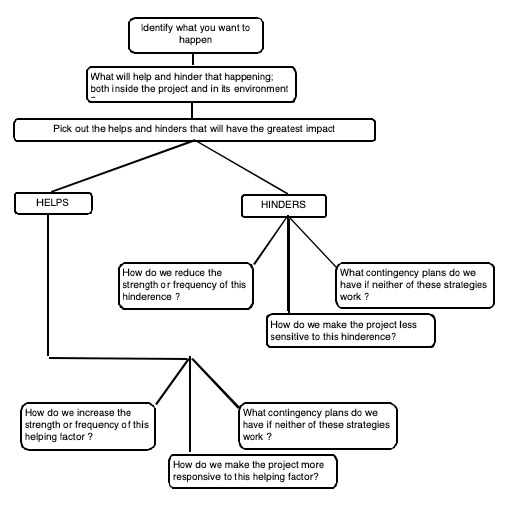
This is an exceptionally useful tool that is essentially the diagram on the right, plus some aspects of the Rand Corporation’s Assumption Based Planning process. Conceptually simple, Force Field Analysis asks the question what helps and hinders whatever it is that you are trying to do, and then what are the strategies that help the helping factors help, and hinder the hindering factors. Far superior in my experience to the classic SWOT analysis, it was developed initially by the great methodologist Kurt Lewin.
I've added a few tweaks, because the answers to Force Field questions often reveal hidden assumptions, so I blended it with the Rand's under-acknowledged Assumption-Based Planning. The download provides a graphic representation of the process and a brief description of the original concept with suggestions for use.
Download: Assumption-Based Planning (PDF)
Discussing Undiscussibles
This tool, also developed by Bob Dick and Tim Dalmau, addresses topics that are never talked about in groups but strongly shape what can be said.
It surfaces the conditions that create hidden boundaries and helps people decide what they want to do about them without needing to talk directly about the undiscussible issues.
Download: Discussing Undiscussibles (PDF)
Ottawa Charter Framework
The Ottawa Charter is a WHO health promotion framework that tackles the mistaken assumption that simply telling people what to do will change their behaviour.
It underpins successful strategies in areas such as smoke‑free workplaces, HIV prevention, road safety and melanoma prevention, and I have applied it to areas like dairying, energy efficiency and land management
The framework looks for voluntary behaviours consistent with a cause and is based on leverage, using a strategically selected mix of people and organisations each doing what they are most effective at.
For the framework to work properly you need (or need to develop) :-
A clear cause (or vision)
A clear set of initial principles or values
Initial agreement to the above by all key stakeholders
The strategy framework has five components, which aim to develop and maintain :-
1. The knowledge and skills required to adopt these behaviours.
2. Relevant services which promote and model the cause.
3. A sense of involvement in and ability to contribute to the cause.
4. Policies and rules which promote the cause.
5. Support from the wider environment for the cause.
To gain leverage, you need a range of strategies across the 5 areas which reinforce each other. You also identify the organisation or individuals most able to develop each part of the strategy.
The nice thing about this framework is that it works at any level you wish to apply it. I have used it at a national level (where for instance rules = legislation), and in single organisations (where services could be the canteen serving up decent food). I find the framework helpful even when doing something which is part of the strategy framework. For instance, if I am trying to developing a "relevant service", the framework helps me to strategise and plan how to develop that service.
The document download has a longer discussion of the framework, plus a couple of non-health examples.
Download: Ottawa Charter Framework (PDF)
Creativity Techniques and Tools for Problem Solving
This website from the UK consultancy Mycoted offers over 200 tools and methods related to action research, large group processes, strategy development, evaluation and more.
Each method is briefly described with enough information to use it relatively safely, making it an exceptionally generous and useful resource.
Visit: Creativity Techniques and Tools for Problem Solving (Mycoted)
A Planning Framework
If you think most planning frameworks look better on paper than in reality, this short framework offers a more grounded way to think through plans.
It aims to reflect how change actually happens rather than forcing work into an overly tidy model.
Download: A Planning Framework(PDF)
Making Evaluations Matter : A Practical Guide For Evaluators
This publication, developed with Cecile Kusters and colleagues from the Centre for Development Innovation in the Netherlands, is an excellent guide to planning, monitoring and evaluation.
You can download it, but the hard‑copy version is well worth purchasing.
Download: Making Evaluations Matter : A Practical Guide For Evaluators (PDF)
A Reflection Tool
This reflection tool, adapted from an idea by Shankar Sankaran, is based on the Plan–Act–Observe–Reflect–Plan cycle in action research.
It uses a dozen or so probing questions to deepen reflection and forms part of a “Learning Log” developed with Bill Harris, described in our chapter in Effective Change Management Using Action Research and Action Learning.
Download: A Reflection Tool (PDF)
Dialogue Methods
David McDonald, Gabriele Bammer and Peter Deane have produced an excellent e‑book on the use of dialogue methods in a variety of settings.
Many of the methods come from systems and organisational development fields and are highly reflective, making this volume well worth a look.
Download: Dialogue MethodsA (PDF)
A Clustering Tool
This process is very effective when you have a room full of people who need to cluster lots of ideas quickly and when you want to expose unspoken assumptions.
Based on a process called “Fastbreak” from work with Pegasus Communications Inc and WEB Research, it has never failed me in practice, even though people often doubt it will work until they try it.
The notes include tips on when to debate cluster membership and how to deal with participants who find the process frustrating.
Download: A Clustering Tool (PDF)
A Sustainability Framework
Although current discourse often emphasises “resilience” and “adaptive management”, I still find the idea of sustainability worth exploring.
Drawing on work with Patricia Rogers reviewing the sustainability literature, this two‑page framework was developed for work with the Lumina Foundation and SPEC Associates. One side explores how to frame sustainability and the other summarises key components the literature identifies as important, regardless of how sustainability is framed.
Download: A Sustainability Framework (PDF)
Creativity Techniques and Tools for Problem Solving
This is a real gem.
Every so often you come across a website that takes your breath away in terms of usefulness and the generosity of those involved. If the UK consultancy called Mycoted are anywhere near as good as their resources then they are a pretty sharp outfit. This website has over 200 different tools and methods relating to action research, large group processes, strategy development, evaluation - just about everything really. Each method has a short description of what it is and just enough information for you to use it relatively safely.
Download: Creativity Techniques and Tools for Problem Solving